You are about to launch on a significant journey in your job search, and understanding interviews is imperative for your success. Interviews serve as formal conversations that assess your qualifications and fit for a role. This blog post will guide you through the various types of interviews and formats you may encounter, empowering you to prepare effectively and increase your chances of standing out in the hiring process.

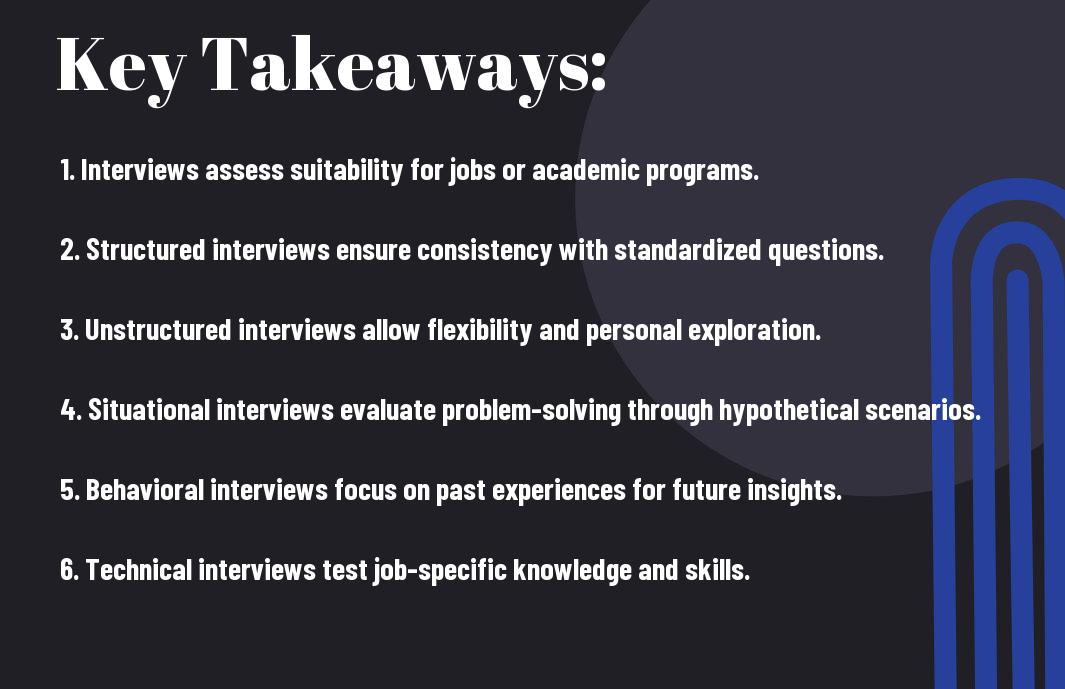
Key Takeaways:
- Definition: An interview is a structured conversation designed to evaluate a person’s qualifications, skills, and suitability for a job or program.
- Types of Interviews: Common types include structured, unstructured, situational, behavioral, stress, and technical interviews, each serving different assessment purposes.
- Interview Formats: Interviews can be conducted in various formats, such as individual, group, panel, and multiple-round interviews, offering different dynamics and evaluation styles.
- Preparation Strategies: Job seekers should tailor their preparation based on the interview type and format, focusing on relevant skills, experiences, and effective communication.
- Evaluation Criteria: Companies look for a range of traits during interviews, including technical expertise, problem-solving abilities, interpersonal skills, and cultural fit.
What is an Interview?
The interview is a formal conversation designed to evaluate your qualifications, skills, and personality traits in relation to a job, academic program, or other opportunities. In essence, it is a structured dialogue in which you, the candidate, engage with an interviewer who poses questions to assess your suitability for the position. This process is not only prevalent in the job market but also extends to academic admissions, journalism, and research, serving as a vital tool for gathering insights and making informed decisions regarding candidates.
The nature of interviews can vary significantly, as they do not adhere to a single format. From structured interviews with predetermined questions to unstructured ones that promote open discussions, being aware of the various types and formats can greatly aid in your preparation. Understanding the interview environment allows you to showcase your strengths effectively while aligning your responses with what prospective employers seek in an ideal candidate. Your ability to adapt to these different formats can enhance your chances of success in landing the opportunity you desire.

The Meaning of ‘Interview’
Clearly, an interview serves as a significant milestone in your journey as a job seeker. It is fundamentally a structured conversation where you engage with an interviewer, whose primary role is to evaluate your suitability for a job, academic program, or other opportunities. During this exchange, they will assess various aspects of your qualifications, skills, and personality traits, aiming to gather insights that help them make informed decisions about your fit within the organization or program.
In many contexts, whether for employment, academic admissions, or research purposes, interviews play a vital role in establishing a connection between individuals. The format of an interview can vary widely, from formal and structured to more relaxed and open-ended, impacting how you present yourself and respond to inquiries. Understanding the meaning of an interview enables you to prepare effectively, positioning you to showcase your abilities and convey your unique value to potential employers or academic institutions.
Types of Interviews
There’s a diverse array of interview types that you may encounter as a job seeker, each designed to evaluate different aspects of your qualifications, skills, and personality. Understanding these types can help you better prepare for the experience and increase your chances of success. Below is a summary of various interview types:
| Type of Interview | Description |
|---|---|
| Structured Interview | Standardized questions for consistent evaluation. |
| Unstructured Interview | Open-ended conversation focusing on personal traits. |
| Situational Interview | Hypothetical challenges to assess problem-solving skills. |
| Behavioral Interview | Past behavior used to predict future performance. |
| Stress Interview | High-pressure environment to evaluate resilience. |
Thou should consider each type carefully and prepare accordingly for the unique demands they present.
Structured Interviews
Types of structured interviews are characterized by a systematic approach to questioning, where each candidate undergoes the same set of predetermined questions. This allows interviewers to conduct assessments in a consistent manner, minimizing bias and ensuring fairness throughout the process. The structured interview format often employs quantitative metrics to evaluate responses, which can lead to a more reliable comparison of candidates’ qualifications.
As a candidate, your preparation should include researching common structured interview questions that pertain to the job you’re applying for and practicing concise, targeted responses that effectively highlight your relevant experiences and skills. This structured approach may provide you with a competitive edge in the hiring process.
Unstructured Interviews
Types of unstructured interviews provide a more flexible and conversational format. In these interviews, the interviewer asks open-ended questions, allowing for a free-flowing dialogue that can investigate deeper into your personality, motivations, and interpersonal skills. While this type of interview can feel more relaxed, it also places considerable emphasis on your ability to articulate your thoughts and experiences organically.
Consequently, you should engage in self-reflection and prepare personal anecdotes that showcase your skills and character. This approach will not only prepare you to respond to unexpected queries but also help establish a genuine connection with the interviewer.
Situational Interviews
Around situational interviews, you will often encounter hypothetical scenarios intended to gauge how you would react to specific job-related challenges. This format evaluates your problem-solving abilities and decision-making process, simulating situations that could arise in the actual work environment. It’s important to stay composed and thoughtfully articulate your approach to these scenarios.
Considering the potential stress these interviews can induce, it’s beneficial to prepare by reviewing the job description and practicing your responses to relevant hypothetical questions. This will help highlight your skills in action and demonstrate your preparedness for the role.
Behavioral Interviews
Types of behavioral interviews focus on past experiences to predict how you may perform in the future. These interviews typically utilize the STAR (Situation, Task, Action, Result) method, enabling you to provide structured and detailed responses. Interviewers aim to uncover specific examples of how you have handled various situations in your previous roles, assessing your soft skills like problem-solving, teamwork, and communication.
Even though these interviews can be demanding, they offer an excellent opportunity to showcase your true abilities. Make sure you prepare concrete examples and refine your storytelling skills to communicate your experiences compellingly.
Stress Interviews
Interviews designed as stress interviews are deliberately conducted in a high-pressure environment to assess your resilience and composure. These interviews may involve rapid-fire questioning or tactics to create discomfort, mirroring the stressful situations you might encounter in the workplace. While these interviews can be intimidating, focusing on how to remain calm can significantly impact your performance.
The goal of a stress interview is to observe how you handle adversity rather than assessing your knowledge directly. Thus, preparing for common stress-inducing techniques and practicing relaxation strategies can help you maintain your focus during the interview.
Technical Interviews
Along with the various types of interviews, technical interviews specifically evaluate your knowledge and skills related to the technical demands of a job. These interviews may involve problem-solving tasks, coding challenges, or practical demonstrations of your technical competencies, tailored to the industry you’re looking to enter.
To effectively prepare for technical interviews, you should engage in hands-on practice and familiarize yourself with the technologies relevant to the position. Tools such as coding platforms or online resources can help you sharpen your skills and build confidence for the technical aspect of the interview process.
To maximize your chances of success, focus on both theory and practical applications within your field. This balanced approach will not only enhance your problem-solving capabilities but also prepare you for the specific challenges presented during technical evaluations.
Types of Interview Formats
Now, when preparing for an interview, it’s important to be aware of the various formats in which these conversations can take place. Understanding these formats will enable you to tailor your preparation effectively to meet the expectations of potential employers. Below is a breakdown of the main types of interview formats you may encounter:
| Interview Format | Description |
|---|---|
| Individual Interviews | One-on-one conversations between the candidate and interviewer. |
| Group Interviews | Involves multiple candidates being interviewed by one or more interviewers at the same time. |
| Panel Interviews | Conducted by a panel of interviewers, often from different areas of the company. |
| Multiple-Round Interviews | Consists of several interview rounds, often including various formats. |
| Informational Interviews | Conversations aimed at gathering information about a company or role. |
Any preparation you undertake will be more effective with a clear understanding of these formats and their distinct features.
Individual Interviews
Across various industries, individual interviews remain one of the most common formats you will encounter. These one-on-one conversations allow the interviewer to dive deeply into your experiences, qualifications, and motivations. This setting provides you the opportunity to establish a personal connection with the interviewer, which can be advantageous in highlighting your fit within the company culture.
It’s crucial to present your skills and experiences clearly and confidently in individual interviews. Preparing specific examples that showcase your capabilities will help draw a direct correlation between your experiences and the job’s requirements.
Group Interviews
Between individual and group dynamics lies the group interview setting, where multiple candidates are assessed simultaneously. This format not only evaluates your individual contributions but also how well you work with others. Group interviews may involve discussions, problem-solving activities, or presentations designed to observe teamwork and communication skills among candidates.
Consequently, be prepared to engage actively and collaboratively with other candidates. Demonstrating leadership qualities, the ability to listen, and supportive interactions can set you apart in this competitive setup.
Panel Interviews
Beside the group interview format, panel interviews involve multiple interviewers assessing a candidate at once. This format provides a broader perspective on how you interact with different stakeholders within an organization. Each panel member may come from diverse functions within the company, allowing them to assess different facets of your skills and competencies.
Panel interviews can be overwhelming due to the varying questioning styles of multiple interviewers; however, they also present an excellent opportunity to showcase your adaptability and ability to engage with a wide range of audiences.
Multiple-Round Interviews
After your initial interview, you may be invited back for multiple rounds as part of the selection process. This format typically involves different interview types, including individual, panel, and perhaps even situational interviews. Each round is designed to evaluate you from different angles, often delving deeper into your professional abilities and cultural fit.
Indeed, preparing for multiple rounds requires a well-rounded approach. Being consistent in your messaging while subtly altering your responses to meet the new contexts presented in each round will help you maintain a strong impression throughout the evaluation process.
Informational Interviews
Types of informational interviews serve a different purpose than traditional job interviews. They are informal conversations that allow you to gather insights about a particular job, company, or industry. You can learn about the company culture, job expectations, and career paths from seasoned professionals, which can significantly influence your job search and career decisions.
Interview sessions like these can enhance your understanding of potential career paths while also expanding your professional network. By making a positive impression, you may often find future employment opportunities through these connections.
Computer-Assisted Interviews
About the evolution of technology, computer-assisted interviews have emerged as a modern format that utilizes software for interviewing processes. Through video platforms or specialized software, these interviews may include pre-recorded questions where you record your responses at your convenience. This format allows employers to streamline their interview process and reach a wider candidate pool.
Interviews conducted through this format may have unique challenges, such as ensuring you appear professional in your environment and managing technical issues. Nonetheless, embracing this innovation allows you to showcase your adaptability in navigating contemporary hiring processes.
What Do Companies Look For During an Interview?
Many employers seek specific qualities and skills that indicate whether you are the right fit for their organization. They assess your qualifications, technical abilities, and experience relevant to the role you are applying for. However, equally important is your interpersonal skill set, as companies value candidates who can effectively communicate, collaborate, and contribute to a positive workplace culture. During the interview process, they often look for evidence of your problem-solving abilities, adaptability, and how well you align with the company’s values and mission.
Additionally, companies pay close attention to your responses and how you present yourself during the interview. If you’re engaged, confident, and articulate, it reflects positively on your potential as a future employee. They may also evaluate your critical thinking skills through situational or behavioral questions, allowing them to gauge how you approach challenges and make decisions. Ultimately, showing that you have not only the technical qualifications but also a strong understanding of human dynamics within the company can significantly enhance your candidacy.
Final Words
Following this comprehensive exploration of interviews, you now have a clearer understanding of the meaning, types, and formats that may arise in your job search. Each type of interview—whether structured, unstructured, situational, behavioral, stress, or technical—offers unique opportunities for you to demonstrate your qualifications and interpersonal skills. By knowing the distinctions among these formats, you can tailor your preparation strategies to align with the expectations of prospective employers, increasing your chances of success.
Moreover, grasping the specific traits of each interview type allows you to adopt effective techniques that will showcase your strengths. As you approach future interviews, leverage the insights provided to navigate the process with confidence. When you are well-prepared and aware of what to anticipate, you empower yourself to leave a positive impression on interviewers and enhance your overall job-seeking experience.
FAQ
Q1: What is the main purpose of an interview?
A: The primary purpose of an interview is to assess a candidate’s suitability for a specific position, academic program, or opportunity through a structured conversation. Interviewers evaluate qualifications, skills, personality traits, and how well the candidate aligns with the requirements of the role. It serves as a platform for both the employer and the candidate to exchange information, allowing the employer to evaluate the candidate and for the candidate to understand the position better.
Q2: What are the different types of interviews job seekers may encounter?
A: Job seekers may encounter several types of interviews, including structured interviews, unstructured interviews, situational interviews, behavioral interviews, stress interviews, technical interviews, one-to-one interviews, and video or phone interviews. Each type has distinct characteristics and evaluation methods, which can impact how a candidate prepares and presents themselves.
Q3: How can candidates effectively prepare for a structured interview?
A: To prepare for a structured interview, candidates should research common questions associated with the position and industry. Practicing clear and concise responses is crucial to highlight relevant skills and experiences. Additionally, understanding the job requirements and aligning answers to demonstrate how one’s qualifications meet those criteria can further enhance preparation.
Q4: What is the significance of the STAR method in behavioral interviews?
A: The STAR method is crucial in behavioral interviews as it provides a structured way of articulating past experiences. STAR stands for Situation, Task, Action, and Result. By using this method, candidates can effectively communicate specific examples of how they handled various situations in the past, demonstrating their skills, problem-solving abilities, and suitability for the role they are applying for.
Q5: What should candidates expect from a technical interview?
A: In a technical interview, candidates can expect to be assessed on specific knowledge, skills, and abilities directly related to the role’s technical requirements. This may involve solving problems, coding tasks, or explaining concepts relevant to the position. It’s crucial for candidates to prepare by reviewing core technical skills, practicing relevant problems, and staying updated on industry trends to demonstrate their competency effectively.